buy ongc @187 sl 182 target 192/197/202
Thursday, 17 May 2018
Wednesday, 16 May 2018
UPDATE 1-Suspected Indian central bank interventions stems rupee's fall
Indian rupee unexpectedly gains on strong RBI intervention
* India bonds also gain taking comfort from rupee
* Rally at risk as macro risks, high oil weigh (Adds details, quotes, bond level)
By Suvashree Choudhury
MUMBAI, May 16 (Reuters) - Suspected currency market intervention by the Reserve Bank of India for a second consecutive day stemmed the rupee's fall, three dealers said after seeing heavy dollar selling from the outset of trade on Wednesday.
The rupee INR=D2 had weakened to a 16-month closing low of 68.15 per dollar on Tuesday, but after the latest round of suspected central bank support it had bounced back to 67.80, despite the dollar's strength on international markets.
"It looks like RBI is in a mood today," said a senior dealer at a state-run bank, estimating that within the first 10 minutes the RBI might have sold $300 million to $400 million proactively to prevent any sharp fall in the rupee.
Sharply rising U.S. dollar yields have boosted the dollar on international exchanges, and the rupee was also coming under pressure from firm crude oil prices that will weigh on India's already widening trade deficit.
Some dealers had anticipated that the RBI might refrain from intervening on Wednesday as it suspected intervention on Tuesday had failed to stop the rupee hitting its weakest level since January 27, 2017.
The rupee swung in nearly one percent intraday range on Tuesday, its most volatile day in about a year. can understand what the RBI wants to do with the rupee. It says it intervenes to curb volatility but sometimes it allows the rupee to move wildly and sometimes it is holding it with a heavy hand," said another dealer at a foreign bank.
Indian bond prices strengthened on the rupee's unexpected recovery.
The 10-year benchmark bond yield < IN071728G=CC stood at 7.88 percent early compared with its previous close of 7.90 percent.
However, both forex and debt traders were doubtful whether the rally in the rupee and Indian bonds would last through the week.
Indeed, bond dealers expect the yield on 10-year paper to cross the 8-percent mark, a level unseen since June, 2015, due to inflation concerns.
Forex traders also expect the rupee to breach the record low 68.8650 level, last touched on November 24, 2016.
"It is quite difficult to sustain the rally given India's weakening macro-economic parameters," said another dealer at a foreign bank.
Indian rupee has been the worst performer in the region, losing more than 5 percent so far in 2018 while inflation risks have increased on high oil prices raising the probability of faster hikes in interest rates by the RBI.
The trade deficit <INTRD=ECI > widened to $13.72 billion in April from $13.25 billion a year ago and could rise further with India importing 80 percent of its oil needs.
Gold's Bearish Breakout-In-Progress Confirms USD Strength
More than any other asset, gold invokes strongly defended positions among both its proponents and detractors. Whether you believe gold is “historically the only true form of hard money” or “just a yellow rock with few industrial uses,” it still pays to keep an eye on the price action and evaluate the current trend.
For more than two years, gold hasn’t shown much of a trend at all, with prices consolidating between $1200 and $1400 (excluding a brief spike down to the mid-$1100s in Q4 2016). More recently, the metal has spent the entire first third of 2018 trapped between $1300 and $1365, frustrating bulls and bears alike.
That may be changing with Tuesday's price action: as of writing, gold was trading hands below $1300, down by more than 1.5% on the back of a breakout in US Treasury yields and the accompanying greenback rally:

Daily Gold
Of course, bears have been wrong-footed by failed breakouts before, so it may be worthwhile to wait for a daily close to confirm the breakdown. That said, gold is currently trading well below the 50% retracement of the December-January rally, opening the door for a continuation down toward the 61.8% ($1286) or 78.6% ($1264) retracements next. Astute readers will note that the 1260 area provided support twice back in October of last year.
Taking a step back, Tuesday’s breakout-in-progress serves as a confirmatory indicator of the recent dollar strength. From an intermarket perspective, as long as gold remains below $1300, it will support the near-term “bullish dollar” thesis.
The Coming Copper Crunch
Copper had one of its best years ever in 2017, rising 27% on the back of supply disruptions and steady demand from China, by far the largest copper consumer.
Commodities analysts are usually wrong about copper supply, always predicting a glut in the market for the ubiquitous metal used in everything from piping for plumbing to wiring in houses, to components of electric vehicles. What they fail to account for is the inevitable stoppages at the major copper mines due mostly to strikes and weather problems.
Commodities analysts are usually wrong about copper supply, always predicting a glut in the market for the ubiquitous metal used in everything from piping for plumbing to wiring in houses, to components of electric vehicles. What they fail to account for is the inevitable stoppages at the major copper mines due mostly to strikes and weather problems.
In 2017 however they were right. In January last year a collection of analysts—from BMI, Goldman Sachs, Citigroup) and TD—were all bullish on copper, saying that after a terrible 2015 and 2016, it would be the strongest performing metal of 2017 with predictions of up to $6,200 a tonne come mid-year. By the end of 2017 copper futures trading on the London Metal Exchange (LME) were at their highest in four years, $7,236.50 a tonne or $3.28 a pound. Copper wasn’t the best performing metal of 2017 (that would be cobalt) but it was third behind palladium.
So how has copper done so far in 2018? The base metal is showing a V-shaped curve, with LME copper starting the year at $7,200 a tonne, bottoming out at $6,499 on March 26, and currently trades at $6,721. Spot copper follows the same pattern. It started 2018 at just under $7,200 and was at $6,782 ($3.08) as of May 4. Copper has traded up sharply since the end of March but has pulled back since the end of April.
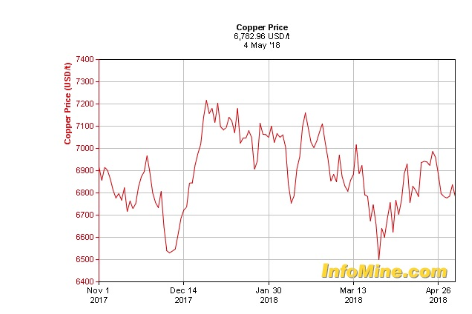
Copper Price in USD
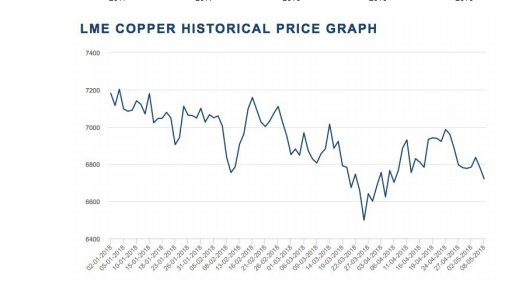
LME Copper, Historical Price Graph
So what's happening with the copper market and what are the prospects for junior copper companies wanting to find the next big discover to be gobbled up by a major? The article embedded below takes a look at the copper market in detail, including uses, the supply-demand trends and pricing.
However, the overall conclusion, based on the details provided, is that copper is heading for a major shortfall. That can only mean one thing: higher prices
Subscribe to:
Comments (Atom)


