
Tuesday, 20 February 2018
Gold Leads Silver
It is widely believed that silver leads gold during bull markets for these metals. I wonder how this belief first arose and persists to this day given that it is contrary to the historical record.
It is partially true that silver outperforms gold during precious-metals bull markets. In particular, it’s true that silver tends to achieve a greater percentage gain than gold from bull-market start to bull-market end. It’s also the case that silver tends to do better during the final year of a cyclical bull market and during the late stages of the intermediate-term rallies that happen within cyclical bull markets. However, the early stages of gold-silver bull markets are characterised by relative strength in gold.
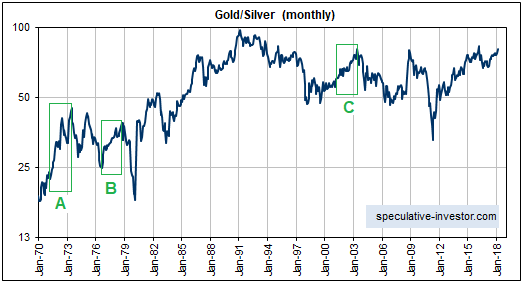
Gold’s leadership in the early stages of bull markets is evidenced by the following long-term chart of the gold/silver ratio. The boxes labeled A, B and C on this chart indicate the first two years of the cyclical precious-metals bull markets of 1971-1974, 1976-1980 and 2001-2011, respectively. Clearly, gold handily outperformed silver during the first two years of each of the last three cyclical precious-metals bull markets that occurred within secular bull markets.
Gold & Silver
Now, in the same way that all poodles are dogs but not all dogs are poodles, the fact that gold tends to strengthen relative to silver in the early years of a precious-metals bull market doesn’t mean that substantial strength in gold relative to silver is indicative of a precious-metals bull market in its early years. For example, there was relentless strength in gold relative to silver from mid-1983 until early-1991 that took the gold/silver ratio as high as 100, but there was no precious-metals bull market during this period.
Between mid-1983 and early-1991 there was, however, a multi-year period when gold, silver, most other metals and mining stocks offered very profitable trading opportunities on the long side. I’m referring to 1985-1987. We are probably in a similar period today, with the next buying opportunity likely to arrive before the end of this quarter.
LNG Comes To Boston, A Harbinger Of The Future?
The most curious natural gas story of the year so far comes out of Boston and seems to have echoes of a deepening Russia-related scandal in Washington. A liquefied natural gas (LNG) tanker bearing natural gas produced in part in Russia delivered its cargo to the Boston area for insertion into the natural gas pipeline system there. Apparently, the Russian company that supplied some of the gas may fall under U.S. sanctions against the financing and importation of Russian goods.
One of the many ironies of the delivery is that the United States is simultaneously importing LNG in one place even as it exports LNG from another. (I'll explain later why this may become a more frequent occurrence in the years ahead.)
The hue and cry from the natural gas partisans blamed Boston's predicament on the lack of pipelines to carry growing gas production from the nearby Marcellus and Utica shale deposits to needy Bostonians whose gas supplies had been depleted by a deep winter freeze.
Within the context of this narrow appraisal, the partisans are mostly correct. Attempts to bring more pipeline gas to New England have come to grief, especially in New York state where residents have strongly opposed new natural gas pipelines and storage facilities.
In addition, the state banned hydraulic fracturing—the main method for extracting gas from the Marcellus and Utica deposits—in 2014, claiming the process threatened water supplies. That ban, of course, prevented any shale gas development in southern New York under which the deposits lie. And, it brought into disrepute all things related to hydraulic fracturing or "fracking" including natural gas pipelines and storage facilities.
What lurks behind the outrage of the partisans is the assumption—widely touted in the media and by the U.S. Energy Information Administration (EIA)—that the country is about to become a large exporter of LNG for the long term as its natural gas production grows ever skyward. Energy abundance, they like to say, has arrived in America.
There's just one problem—or should I say four? Of the six major U.S. shale gas plays that are the basis for the optimism about supply, four are already in steep decline. (Gas produced from other types of deposits has been either flat or in decline for many years.) As of the end of 2017 the rate of natural gas production in the Barnett play in Texas, the Fayetteville play in Arkansas, and the Haynesville play spanning the area where Arkansas, Louisiana and Texas meet are all coincidentally down by about the same 44 percent from their peaks years ago. The Woodford play is down about 25 percent from its 2016 peak.
That leaves only the Marcellus and Utica plays mentioned previously to carry the United States into an era of continuously climbing overall natural gas production. That's an unlikely prospect and one rated as such by David Hughes, author of "Shale Reality Check." For his analysis, Hughes meticulously checked the actual well production histories of shale gas wells—rather than merely scanning misleading energy headlines as most other analysts seem to do.
Even the Marcellus is showing its age as the rate of production from new wells sags, a sign that the most productive prospects have already been drilled. In addition, a preliminary production peak in the Marcellus in early 2017 waits to be confirmed.
If the optimistic scenarios for U.S. natural gas production fail to materialize as seems likely, we will almost certainly see more LNG-related irony as imports and exports occur simultaneously at the country's LNG terminals. This is because long-term delivery contracts entered into by LNG export terminals will prevent any rerouting of gas bound for export to domestic use, possibly even under emergency conditions. If the shale gas boom fizzles, we will discover that government approvals for U.S. export terminals were wildly ill-advised as more LNG delivery ships dock near Boston and other places to make up in part for outgoing U.S. LNG cargoes .
Subscribe to:
Comments (Atom)